

In February 2026, the UK advertising regulator banned several major brands for making unsubstantiated claims about being "sustainable," proving that greenwash nappies are more common than many parents realise.
It's deeply frustrating to try and make an ethical choice for your baby whilst being bombarded by vague leafy logos, especially when conventional disposables can take over 450 years to degrade in a landfill. You deserve to feel confident that the products touching your baby's skin are as gentle and honest as they claim to be. Transparency is the only solution.
We've created this guide to help you look past marketing jargon and find truly supportive options, such as our nappies that are 80% plant-based and made using compostable plant-based materials wherever possible. You'll learn how to evaluate the new 2026 EU Green Claims Directive and the UK's updated CMA guidance to ensure your purchases support genuine environmental progress. We'll provide a clear framework for identifying high-performance nappies and packaging that is fully recyclable or compostable, ensuring you can protect your baby's health and the planet simultaneously.
Key Takeaways
- Identify the common red flags of greenwash nappies by prioritising specific material percentages over vague, leafy marketing logos.
- Understand why absolute claims like "100% biodegradable" are often misleading and how the 80% plant-based standard provides a more honest alternative for your baby.
- Discover how the 2026 regulatory changes in the UK and EU are empowering parents to demand clearer, more factual evidence from nappy brands.
- Learn how to verify a brand's integrity by looking for specific ingredient facts and packaging that's clearly marked as fully recyclable or compostable.
- See how choosing nappies made using compostable plant-based materials wherever possible can provide superior comfort whilst protecting the world your baby will inherit.
What is Greenwashing in the Nappy Industry?
To understand the challenge of finding truly responsible products, we must first ask: What is greenwashing? In the world of mass consumerism, it's a deceptive marketing tactic where brands portray their products as more environmentally friendly than they truly are. This often targets the natural desire to protect your baby's future, exploiting parental guilt whilst failing to deliver on environmental promises. Many greenwash nappies rely on a "halo effect," using soft colours, misleading names and leafy logos to distract you from the actual material composition of the product.
Transparency is the only cure.
In February 2026, the UK's Advertising Standards Authority (ASA) took a significant stand. They banned advertisements from several prominent manufacturers for making unsubstantiated claims. These companies were pulled up for describing their products as "sustainable" and "biodegradable" without providing the necessary proof. This ruling was a vital step in protecting parents from being misled. It reminds us that a brand's commitment must be backed by evidence, not just elegant phrasing.
Why Vague Terms Like 'Eco-Friendly' are Red Flags
Terms like "eco" and “pure” are not legally protected descriptors. This means any company can use them without third party verification. You might find standard plastic nappies wrapped in green packaging to create an illusion of sustainability or standard plastic nappies claiming eco-friendliness because they use some solar power in the manufacturing.
These vague terms are designed to provide a sense of quiet reassurance without the accountability of specific data or ingredient-level transparency. Without clear percentages, "eco-friendly" is often just a hollow promise.
The Rise of “enhanced” Nappy materials
It's easy to be swayed by a label that says "enhanced," but the reality is often more complex. Some materials contain less than 30% plant-based content and are predominantly still oil based plastic. To avoid greenwash nappies, you should look for specific % claims for each rather than broad claims.
We believe in being honest; we describe our nappies as 80% plant-based and ensure they are made using compostable plant-based materials wherever possible. This level of detail helps you feel confident that your choice supports both your baby's skin health and the long term health of the environment.
Annoyingly, the Green Claims Code does not require all manufacturers to state their nappy ingredients or composition. In fact, plastic standard nappies do not have to state any ingredients on their packaging at all. They hide the truth in their complete silence.
Decoding Labels: 'Biodegradable'
Walking down the nappy aisle can feel like a test of your environmental knowledge. You'll see bold claims of "100% biodegradable" or "fully compostable" splashed across colourful packs. Whilst these terms sound like the perfect solution for a conscious parent, they are frequently used to create greenwash nappies.
A nappy is a complex product. It contains elastics, adhesive tabs, and absorbent cores that simply don't vanish into the earth. Claiming an entire disposable nappy is biodegradable is misleading because it ignores these essential, non-plant-based components.
We believe in a more honest approach. Instead of using vague adjectives, we use the specific standard of being 80% plant-based. This metric is transparent; it tells you exactly how much of your baby's nappy comes from renewable sources rather than petroleum. By choosing FSC-certified bamboo, we utilise a regenerative, fast-growing resource that doesn't rely on the heavy oil-refining industry. Mama Bamboo uses compostable plant-based materials wherever possible to reduce carbon footprints and provide a softer, more breathable experience for your little one's skin.
Of course, you’ll also see lots of well known brands of nappies with no specific claims. You can be very sure, if they aren’t stating any plant-based or compostable materials, then the entire product is oil-based plastic and the most damaging to the environment and your baby’s skin.
The Reality of UK Landfills
The truth about waste is often hidden. Most nappies in the UK end up in landfill, where the conditions are anaerobic, meaning there is no oxygen. In this environment, even materials labelled as "biodegradable" struggle to break down quickly. This is why the "80% plant-based" label is more truthful and relevant.
Most nappies in the UK are not buried in landfill but rather burnt in incinerators. Here the materials used in production become very important. The higher the % of plant based material, the lower the impact and emissions. Our nappies produce 6x less harmful emissions than oil based nappies.
Mama Bamboo is working with UCL on a programme of research into commercial-scale composting for nappies in UK and campaigns with DEFRA for the establishment of nationwide kerbside collection and processing. Research in this area is at an exciting stage with the advent of biodegradable SAPs and enzyme composters. It is strongly believed by the community that a 100% compostable nappy will be a reality within 5 years.
In the meantime, plastic based brands would have you believe recycling is the answer. They prefer to push the responsibility for clean up down to consumers rather than tackle the problem at source choosing better input materials. Unfortunately recycling has been proven to be a less environmentally conscious approach due to the high energy requirements to recycle the products and the low value recovered material which will end up in landfill or buried in land releasing microplastics for centuries.
Production Carbon
It isn't just about what happens at the end of the nappy's life; it's about the carbon-neutral production phase as well. By using plants that absorbed CO2 whilst growing, we significantly reduce the environmental burden before the nappy even reaches your changing table.
Mama Bamboo also supports an afforestation programme in Uganda to ensure the entire production, logistics and end-of-life residual carbon is offset by 110%; meaning our business and your products result in a net positive for the planet.
Water Water Everywhere
An often overlooked resource in the production of nappies but of crucial importance to the planet. Oil based plastic require enormous amounts of water in the production process, as does cotton. Simply switching to any plant-based resource is not a guarantee of water conservation. Mama Bamboo chose bamboo as the most sustainable natural resource due to its ability to grow very fast and regenerate organically with very low water usage.
What 'Fully Recyclable or Compostable' Packaging Actually Means
Precision matters when it comes to your household waste. You won't find us using the term "plastic-free" because it can be technically inaccurate and confusing. Instead, we describe our packaging as fully recyclable or compostable. This gives you a clear guide on how to dispose of it amongst your usual collections. If you are looking for a brand that prioritises this level of honesty, you might enjoy exploring our range of Bamboo Nappies designed with both your baby and the planet in mind.
Many brands have switched to paper packaging recently which signals “eco” and responsible, but many are unfortunately waxed or lined with plastic to enable them to withstand the stresses of distribution and provide some moisture protection. This makes this material almost impossible to recycle or compost.
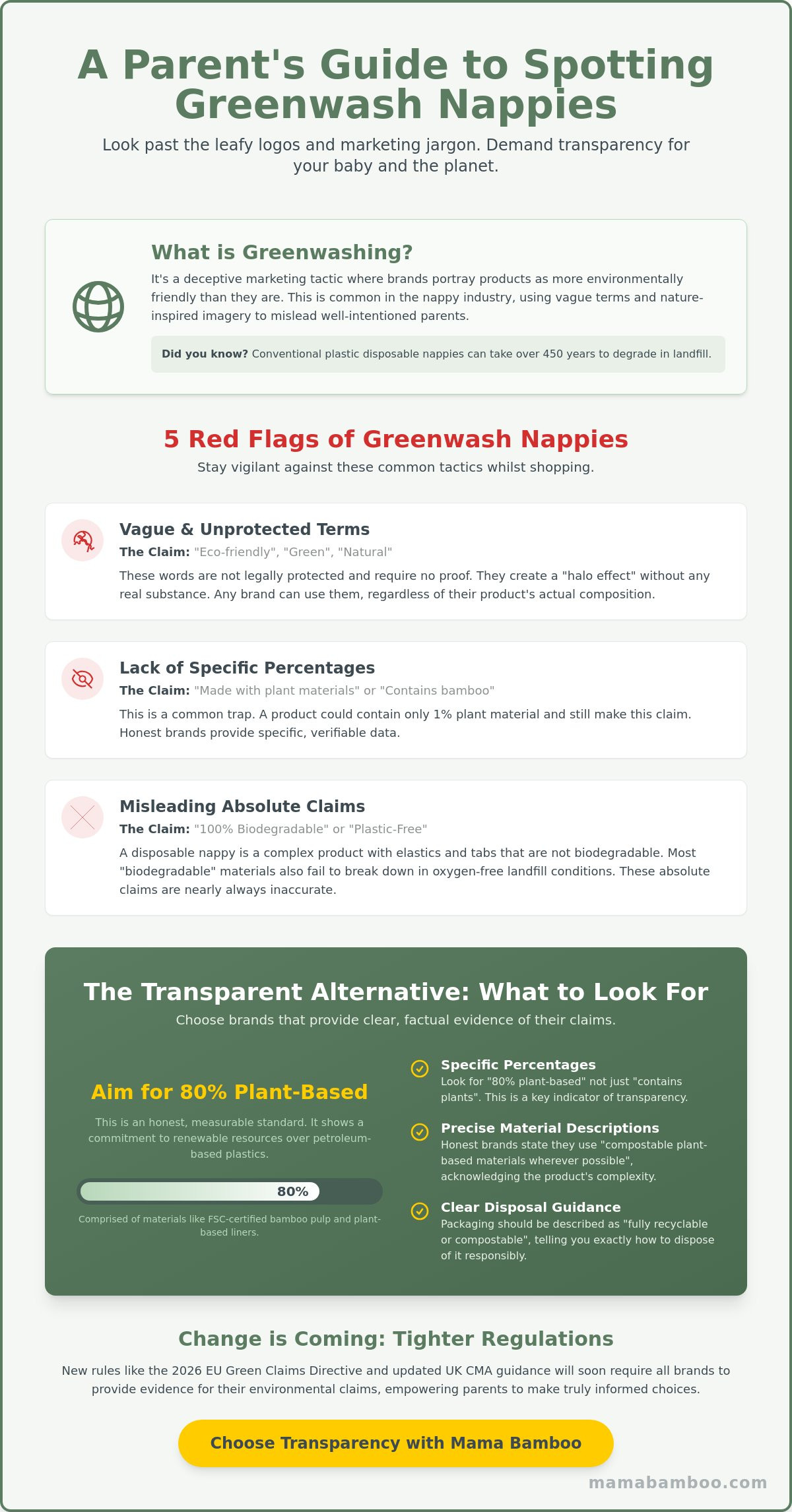
5 Red Flags to Spot Greenwash Nappies Whilst Shopping
Identifying greenwash nappies during a busy shop requires a keen eye for detail. Marketing teams often use emotional imagery and soft colours to mask a lack of substance. By staying vigilant against these five common red flags, you can support businesses that prioritise the next generation's well-being over simple profit margins. Transparency is the only way to ensure your purchase truly aligns with your values.
-
Lack of specific percentages: "cotton-enhanced" is a common trap. Truly honest brands will specify if a nappy is 80% plant-based rather than using vague descriptions.
-
Absolute claims: Any disposable nappy claiming to be "100% biodegradable" is misleading. This claim ignores the essential SAP, elastics and adhesive tabs that don't break down.
-
Hidden plastics: Many "natural" nappies with plant-based covers contain hidden plastic liners within the core. Look for clear material breakdowns to avoid contributing to plastic waste
-
Unclear packaging disposal: Avoid the term "plastic-free" in favour of packaging that is clearly marked as fully recyclable or compostable.
The Importance of Third-Party Certifications
Trust is built on verification. A B-Corp certification is one of the most rigorous assessments a business can undergo; it proves a commitment to social and environmental impact that goes far beyond profit. Similarly, the FSC (Forest Stewardship Council) logo is a vital marker. It ensures that the bamboo or wood pulp used in your baby's nappies is sourced from responsibly managed forests that protect biodiversity and local communities. These certifications help you bypass greenwash nappies and find brands that lead through transparency. Ethical sourcing isn't limited to nappies; for instance, you can discover WoodSnap and their range of custom photo prints made from sustainably sourced birch wood, reflecting a similar commitment to environmental integrity.
The Mama Bamboo Approach: Transparency Over Buzzwords
Choosing the right products for your family shouldn't feel like a constant battle against marketing fluff. At Mama Bamboo, we believe that quiet reassurance comes from hard facts, not vague adjectives. As a B-Corp certified leader, we prioritise factual accuracy in every claim we make. This means we don't hide behind the "eco" labels that often define greenwash nappies. Instead, we provide clear, ingredient-level transparency so you can make informed decisions for your baby's comfort and the planet's future.
Our commitment is rooted in high performance and lower environmental impact. By ensuring our nappies are 80% plant-based and made using compostable plant-based materials wherever possible, we offer a tangible alternative to standard disposables. This isn't just about a "green" image; it's about a carbon-neutral commitment supported by packaging that is fully recyclable or compostable. For a deeper dive into how we balance performance with integrity, we encourage you to read The Ultimate Guide to Bamboo Nappies: Better for Baby, Kinder to the Planet.
Joining the B-Corp Movement
Being a B-Corp means our responsibility is woven into our legal DNA. We are required to consider our impact on the planet and our community, not just our bottom line. This certification acts as a shield against the practices that create greenwash nappies, ensuring our innovation is always backed by rigorous, independent assessment. We invite you to join a community that values softness, environmental integrity, and the simple peace of mind that comes from knowing exactly what is inside every nappy change. Together, we can lead the way toward a more mindful future.
Choosing Clarity for Your Baby's Future
You now have the tools to look past the leafy logos and vague promises that define greenwash nappies. By prioritising specific data, such as the 80% plant-based standard, and checking for B-Corp certification, you can ensure your purchases reflect your values. Parenting involves enough guesswork; the safety and environmental impact of your baby's nappies shouldn't be part of it. Choosing products with material-level transparency allows you to provide the best care for your little one without compromising on your ethical standards.
We're proud to lead this movement through honesty and award-winning quality. As a B-Corp Certified business and winner of multiple Mother & Baby Awards, we focus on what truly matters: high-performance products made with 80% plant-based materials. Our commitment to using compostable plant-based materials wherever possible ensures your baby stays comfortable whilst you protect their world. It's about making a choice that feels right today and remains right for the years to come.
Choose 80% plant-based nappies you can trust—shop Mama Bamboo today.
Frequently Asked Questions
Are there any nappies that are 100% biodegradable?
No disposable nappy currently on the market is 100% biodegradable. Because every disposable nappy requires elastics, adhesive tabs, and specialised absorbent cores (SAP) to function, they inevitably contain some non-plant-based materials. Brands making absolute claims of being "100% biodegradable" are often promoting greenwash nappies. We believe it's more honest to state that a nappy is 80% plant-based, providing you with a transparent metric you can actually trust for your baby's care.
Is it greenwashing to call a nappy 'plant-based' if it still goes to landfill or incinerator?
Calling a nappy plant-based is an honest description of its material origins, even if it eventually goes to landfill or incinerator. This term highlights that the product is made from renewable resources like bamboo which absorb carbon whilst growing and release fewer harmful emissions if burnt at end-of-life.
However, it becomes a feature of greenwash nappies if the brand implies the product will break down completely in a landfill's anaerobic conditions. The focus should be on the reduced environmental impact of the whole cycle.
Why is the term 'plastic-free' often considered misleading for nappy packaging?
The term "plastic-free" is often avoided because it makes an absolute claim that is difficult to verify technically. Instead, we use the more accurate description of packaging being fully recyclable or compostable. This focuses on the end-of-life cycle, guiding you on how to dispose of the wrap amongst your usual household collections. It ensures you have the correct information to manage waste responsibly without being misled by broad material composition claims or unrecyclable waxed or lined paper.


